The Operational Reconciliation Advantage: Driving Control, Scale, and Confidence in Capital Markets
Blog post
Share
Capital markets are at an inflection point. Transaction volumes are accelerating. Asset classes are expanding. Instant payments and distributed ledger ecosystems are reshaping how value moves.
Yet amid this complexity, one foundational truth remains: If reconciliation is fragmented, the value chain is too.
The recent Datos Insights study, Frictionless Data Flow: How Reconciliation Streamlines the Value Chain, reinforces what many financial leaders already recognize: reconciliation is no longer a reactive control function. It is strategic infrastructure.
And firms that treat it that way are gaining measurable advantage.
The Cost of Fragmentation
According to the study, the top reconciliation challenges cited by capital markets firms are:
- Data sourcing and integration complexities (73%)
- Lack of automation and AI-driven efficiencies (46%)
- Poor data quality (46%)
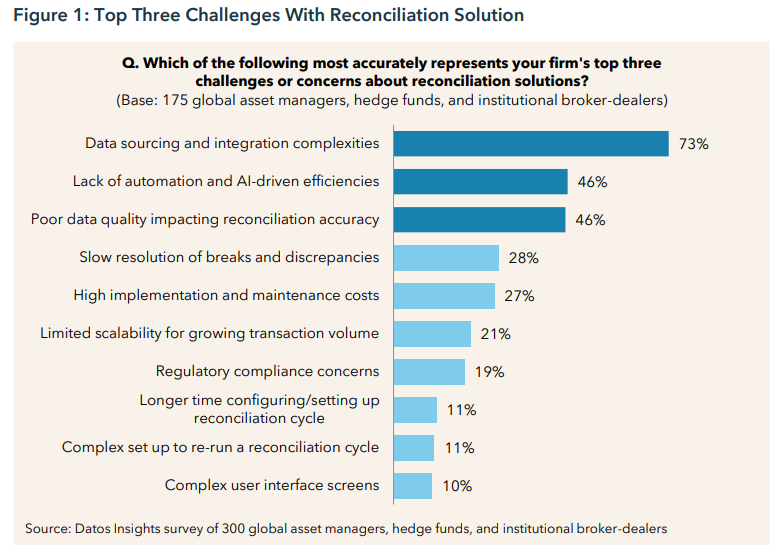
The common denominator? Fragmentation due to disparate systems, manual intervention and inconsistent data standards across departments.
Operational teams are under increased pressure to meet audit and regulatory demands to substantiate trades and positions, yet the environment continues to get more complex.
When breaks occur, balance-to-balance reconciliations cannot get to the detail level needed to resolve them quickly, creating unnecessary write-offs and other issues. While 71% of firms report resolving payment breaks within the same day, more complex reconciliations—such as securities and accounting—lag significantly. Working with a vendor that can drill down to the transaction level detail is crucial to resolving breaks at the pace that the capital markets sector requires.
The impact of fragmented systems is tangible:
- Higher operational costs
- Slower close cycles
- Increased audit friction
When Reconciliation Becomes Strategic
The Datos study highlights two Tier-1 global investment firms—Trintech customers—that demonstrate what transformation looks like when reconciliation is treated as a scalable control framework rather than a patchwork workflow.
Case Study 1: Scaling Control in a Multi-Custodian Environment
A Tier-1 U.S. investment services firm managing more than 100,000 daily securities transactions across five custodians faced growing operational strain.
Inconsistent file formats (SWIFT, Excel, XML, CSV), trade-date versus settlement-date timing differences, and asset identifier discrepancies created excess breaks and heavy manual intervention. As volumes grew and new asset classes were introduced, position-based reconciliation limited visibility and audit readiness.
Rather than automate fragmented processes, the firm transitioned to transaction-level reconciliation on Trintech’s platform, implementing a rules-driven framework to:
- Automate high-volume matching with configurable tolerances
- Standardize reconciliation logic across custodians
- Classify and intelligently route exceptions
- Separate timing differences from actionable breaks
- Deliver real-time reporting and audit visibility
The results were transformative:
- Auto-match rates exceeding 95% and thousands fewer manual exceptions daily
- Reduced break aging and clearer ownership
- Enhanced audit transparency
- Scalable growth without additional headcount
By modernizing its reconciliation model, the firm moved from reactive exception handling to proactive control management—strengthening resilience while maintaining rigorous compliance standards.
We’ve achieved an auto-match rate of more than 95%. That’s thousands of exceptions we no longer touch manually. It’s a game-changer for securities reconciliation.”
Case Study 2: Enterprise-Scale Transformation at a Global Broker-Dealer
Another Tier-1 U.S. broker-dealer processes 60–80 million transactions daily from more than 100 source systems and over 2,000 nightly file feeds across global markets.
The scale alone presented challenges: fragmented workflows, limited real-time analytics, manual break triage, and data archiving constraints—all contributing to operational inefficiencies and audit pressure.
Using Trintech’s securities reconciliation platform, the firm centralized and automated its control framework to:
- Standardize high-volume batch reconciliations
- Enable full-integrity reconciliations across balances and transactions
- Automate break assignment based on asset class and business rules
- Consolidate workflows into a unified process
- Provide real-time dashboards and rule-performance analytics
The outcome:
- 60–80 million transactions processed daily at enterprise scale
- Systematic break assignment reducing manual triage
- Stronger balance sheet integrity
- Enhanced global visibility across portfolios
- Improved audit readiness and control consistency
By embedding automation and structured controls, the firm transformed a complex, batch-driven environment into an analytics-enabled risk management framework positioned for sustained growth.
From Cost Center to Competitive Advantage
Reconciliation health directly impacts liquidity management, financial reporting accuracy, and regulatory confidence. When reconciliation works, the entire value chain accelerates. When it doesn’t, friction compounds.
Leading capital markets firms are no longer asking how to resolve breaks faster. They are asking how to predict and prevent them, eliminating systemic inefficiencies completely.
They are also recognizing that traditional ERP systems were not designed to manage the transaction volume and complexity of modern securities environments. Instead, they are investing in purpose-built reconciliation platforms engineered specifically for capital markets scale.
Built for Capital Markets Complexity
Whether you are a broker-dealer managing high-frequency trades, a custodian safeguarding global assets, or an asset manager overseeing complex fund structures, reconciliation must operate at the speed of the market.
Trintech helps firms:
- Scale without increasing headcount
- Strengthen governance and audit readiness
- Improve operational efficiency
- Close with confidence
Control risk at the transaction level. Close with confidence at the reporting level.
Because in today’s capital markets environment, frictionless data flow is not an aspiration, it is a requirement.
Discuss your top challenges with us. Request a demo.
Written By: Annie Cashman